Tell us about the job
Takes about a minute. No obligation.
A furnace contractor working a repair call here has to settle a question before anything else: did this part fail because the system is old and worn, or because the load this climate puts on heating equipment has ground it down ahead of schedule. 209 severe weather events were recorded in Susquehanna County, Pennsylvania between 2015 and 2024. At that rate, severe weather is a standing feature of operating in this county, not an occasional event, and it shows up inside systems as stress on heat exchangers, ignitors, and blower motors that run hard through rough winters. A part that looks simply old may have hit its limit years early. That distinction changes what the contractor orders and what they tell the homeowner to expect next.
Ductwork in a house that has been heated through as many winters as most in Susquehanna County tells a story in rust stains, tape failures, and joints that have shifted. Half the homes in Susquehanna County, Pennsylvania were built in 1975 or earlier (2020-2024 ACS 5-year). That means a contractor opening a furnace here is working inside a system that has already outlasted at least one previous unit, and the parts that fit it are not always what a distributor stocks today. A heat exchanger crack or a failed inducer motor sounds straightforward until the model turns out to take a component that ships on a three-week lead or does not ship at all. The age of the housing is the reason the repair call sometimes becomes a longer conversation than the homeowner expected.
The Parts of a Furnace a Contractor Checks First
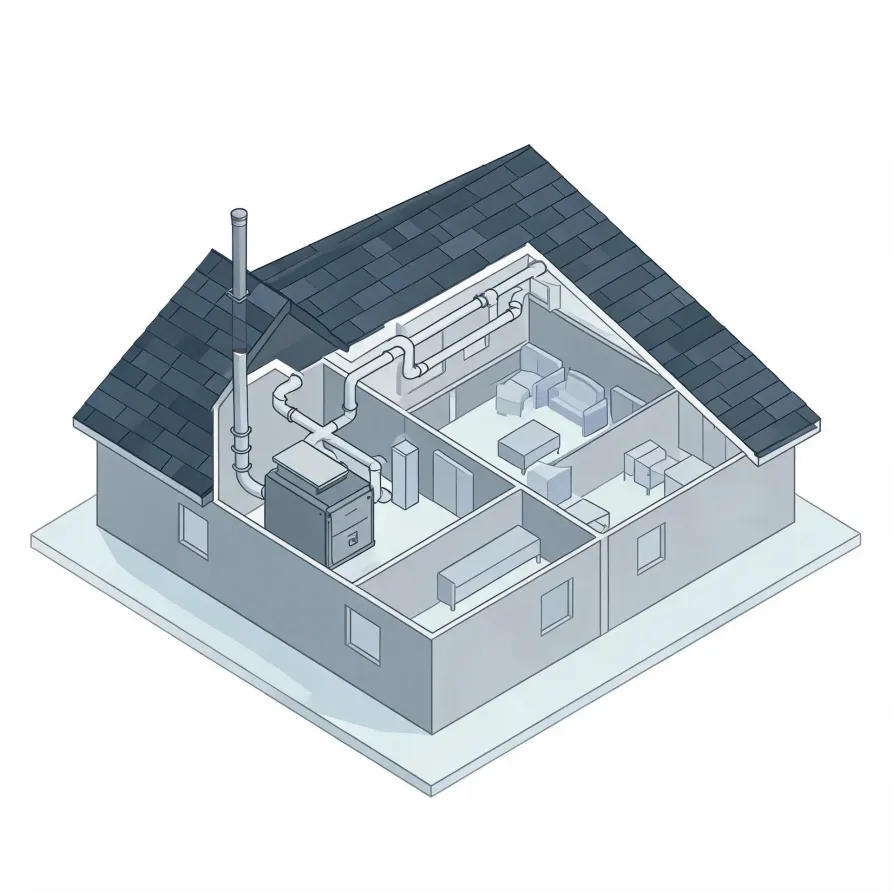
The furnace itself sits in a basement, utility room, or closet and is the piece doing the heaviest work. Inside it, the heat exchanger is what a contractor looks at closely when a furnace runs but fails to heat properly or when carbon monoxide is a concern. The burners, which sit just below the heat exchanger, are checked when the furnace short-cycles or won't ignite.
The blower motor and its fan wheel push conditioned air out through the supply side of the house and are common culprits when airflow feels weak or the furnace runs loudly. The flue pipe exits the furnace and carries combustion gases out of the house. A contractor also checks the control board and the inducer motor, which together govern ignition and venting.
The drawing shows a general layout of these components, and a licensed contractor determines what applies to your specific system and installation.
Find a contractor in Susquehanna CountySusquehanna County, by the numbers
209 severe weather events were recorded in Susquehanna County, Pennsylvania between 2015 and 2024.
NOAA National Centers for Environmental Information, Storm Events Database, bulk CSV export, events 2015-01-01 through 2024-12-31.Half the homes in Susquehanna County, Pennsylvania were built in 1975 or earlier (2020-2024 ACS 5-year).
U.S. Census Bureau, 2020-2024 American Community Survey 5-Year EstimatesSusquehanna County, Pennsylvania holds 21,348 housing units (2020-2024 ACS 5-year).
U.S. Census Bureau, 2020-2024 American Community Survey 5-Year EstimatesOwners occupy 78.5% of the occupied homes in Susquehanna County, Pennsylvania (2020-2024 ACS 5-year).
U.S. Census Bureau, 2020-2024 American Community Survey 5-Year EstimatesCodes & Standards Behind Furnace Repair in Susquehanna County, Pennsylvania7 sourced rules and standards
What HVAC Repair Looks Like in Susquehanna County
Non-weatherized gas furnaces manufactured on or after November 19, 2015 must reach 80.0 percent AFUE.
Non-weatherized oil-fired furnaces manufactured on or after November 19, 2015 must reach 83.0 percent AFUE.
Mobile home gas furnaces manufactured on or after November 19, 2015 must reach 80.0 percent AFUE.
Non-weatherized gas furnaces manufactured on or after December 18, 2028 must reach 95.0 percent AFUE, up from the 80.0 percent minimum that applies to units manufactured before that date.
Licensing Rules for HVAC Repair in Susquehanna County, Pennsylvania
Pennsylvania names the trade in its own definition: installing central heating or air conditioning is a home improvement under the Act, whether or not the equipment is affixed — so an HVAC installation is work the registration requirement reaches.
A Pennsylvania registration displaces the local one: no political subdivision may require a home improvement contractor to register, license or pay a fee on top of it, though building permits and local code enforcement still apply.
Pennsylvania requires home improvement contractor registration rather than a licence: nobody may hold themselves out as a contractor, or perform any home improvement, without first registering with the Bureau of Consumer Protection.
Weather Stress on HVAC Equipment in Susquehanna County
Heating equipment in this part of Pennsylvania works against real atmospheric pressure, not just calendar seasons. How hard a furnace runs, and how often it fails, tracks closely with what the weather here actually does.
209 severe weather events, 2015–2024. Source: NOAA National Centers for Environmental Information, Storm Events Database.